Abstract
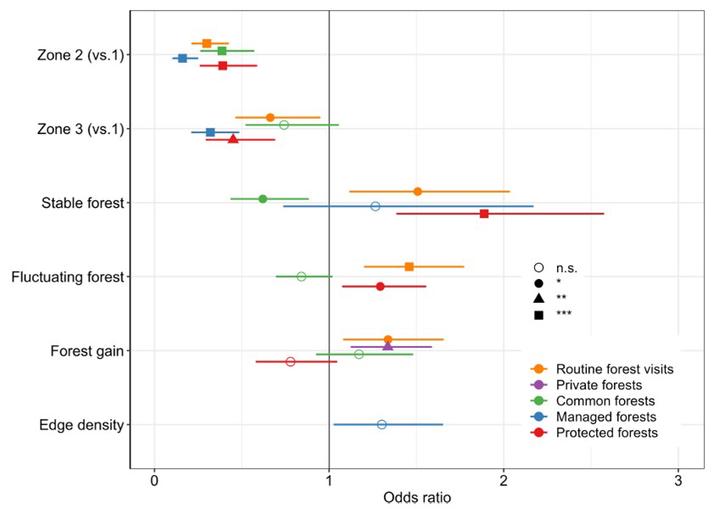
Introduction - Forests support crucial ecosystem services globally, and contribute to the livelihoods of millions of people,but are threatened by agricultural expansion and intensification.Yet the relationship between forest cover and agricultural intensification, and how it mediates people’s access to and use of resources has been seldom studied globally. Methods - Using remote sensing imagery and household surveys, we analyzed the effects of forest cover change on forest access (visitation) and household use of resources along a gradient from lower to higher land use intensification across seven tropical landscapes in low and middle income countries. Results - We find that increased agricultural intensification lowered forest visitation in the high intensification zone compared to the low to medium intensification zones. Forest types andc hanges, such as stable forests, forest gains and edge density, positively impacted household use of forest-sourced food and construction materials and visitation,highlighting the importance of sustainable forestmanagement.Discussion - Our results complement the evidence of forest cover change by looking at agricultural intensification zones, which reveal the site-specific trends of forest types, ownership and household demand for ecosystem services. We recommend integrated landscape approaches with context and site-specific solutions to address the variability of forest types and multiple management goals that can be achieved with agricultural production and equitable access to provisioning goods and services in complex multi-functional landscapes.