Abstract
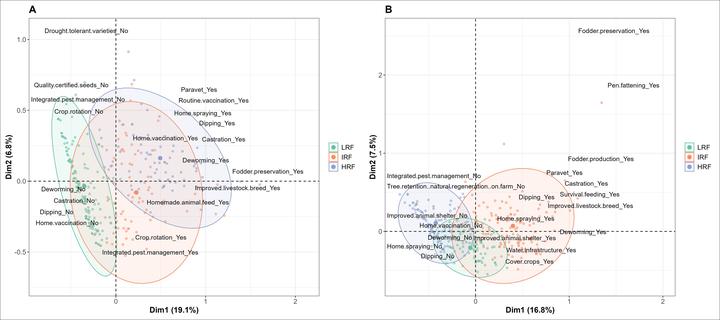
CONTEXT: Improved farming practices could contribute to solving food insecurity and poverty among smallholder farmers in Zimbabwe, who are dominantly mixed crop-livestock farmers. Agroecological practices, which rely on the use and recycling of local resources to reduce dependency on costly external inputs, are increasingly being claimed as suitable options for resource-constrained farmers. OBJECTIVE: The objective of this study was to assess how the use of improved crop and livestock practices, including agroecological ones, varied among different farm types. We hypothesised that agroecological practices would be preferentially used by farms with lower resource-endowment. METHODS: Data from a household survey of 605 farms across a representative sub-humid district and a representative semi-arid district in Zimbabwe, documenting the use of 32 common improved crop and livestock practices, 14 of which were classified as agroecological, were used for this study. A farm typology based on practice use was delineated using Multiple Correspondence Analysis, after which the socio-economic characteristics of the farm types and their associations with farm performance were assessed. RESULTS AND CONCLUSIONS: Our analysis revealed that farmers using a broader range of improved practices – including agroecological ones – were generally the wealthier and more resource-endowed households. Importantly, we found that these same farms were also more diverse in crop and livestock species, indicating that farm diversity was positively associated with productive capacity and resource endowment, rather than being a compensatory strategy of poorer households. Furthermore, we observed limited and inconsistent associations between the use of improved practices and production or diet outcomes. SIGNIFICANCE: The study points to the need for targeted support to less-endowed households, addressing not only technical but also socio-economic and institutional constraints to diversification and the use of improved practices.