Abstract
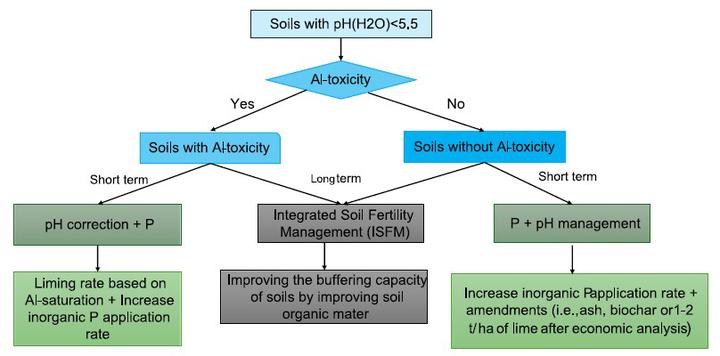
Soil acidity is considered one of the most pressing problems for crop production in Ethiopia. Yet, estimates of the total area of acidic soils, defined here as soils with a pH value below 5.5, and of the proportion of acidic soils affected by aluminium toxicity are inconsistent. The aims of this review are: (1) to highlight the main challenges of soil acidity for crop production, (2) to review the evidence of crop responses to lime and phosphorus (P) on acidic soils from field and pot trials from Ethiopia, (3) to review policy documents on acidic soils and extent of soil acidity in Ethiopia and (4) to propose an agenda for future research. Soils can be acidified either by natural weathering processes or suboptimal management during crop production. Soil acidity affects crops through its effects on nutrient availability (mainly P availability and basic cations) and toxicities of aluminium and manganese. A review of studies of crop response to lime and P on acidic soils showed that in most studies, lime alone did not improve crop productivity. In contrast, application of P or combinations of lime and P together improved crop productivity. Re-interpretation of old documents, soil maps and recent digital soil maps revealed that about 4 % of the total Ethiopian land mass suffers from aluminium toxicity. Ethiopia’s policy on acidic soil aims to improve the agricultural lime supply and increase the use of lime on acidic soils for increased productivity and fertilizer use efficiency. However, after reviewing studies on acidic soil management that reported crop response and the limited coverage of acidic soils with aluminium toxicity, the available evidence suggests that most acidic soils in Ethiopia can be effectively managed by supplying additional nutrients. This suggests that the focus of research for development should be broadened to integrated soil fertility management, tailored to local conditions, where lime use is targeted to aluminium toxic, acidic soils.